
Formation of the Cities on the Palos Verdes Peninsula
Formation of the Cities on the Palos Verdes Peninsula
The Great Depression, which began in 1929, had an extremely debilitating effect on the original unincorporated Palos Verdes Project. Many lot owners defaulted on their property taxes, and the Palos Verdes Homeowners Association, which maintained the Project, was in deep financial straits. Notwithstanding that the public properties, including the beach and golf clubs, were devoted to public uses, the land was taxable as private property because it was owned by the Homes Assn.
By1938 the Homes Association owed the State of California $50,000 for taxes and feared that the State of California might sell these public properties at tax sale, and the community would lose its most valuable assets.
An election was held in December, 1939, at which the voters decided to form the city of Palos Verdes Estates to have taxing authority and to solve the financial crisis.
Immediately upon the organization of the City of Palos Verdes Estates in July, 1940, all of the park lands, the swimming club and the golf club were transferred to the City, and the back taxes were forgiven by the State. The Miraleste section of the Palos Verdes project remained unincorporated, but subject to the deed restrictions of the Palos Verdes Homeowners Association and the Palos Verdes Art Jury.
The City of Rolling Hills Estates officially became Los Angeles County’s 60th municipality on September 18, 1957. In that first year, the City’s population totaled only 3,500. Annexation of new areas to the City was another ongoing concern during the City’s early years. In 1958, areas were added to the eastern and western portions of the City. Later annexations from 1960-66 included numerous recently constructed housing developments. In 1982, the site of the former Palos Verdes Landfill was annexed to assure that City concerns regarding this closed facility would be recognized.
The City of Rolling Hills was also incorporated in 1957. The Rolling Hills City Hall was constructed in 1967. Rolling Hills is a gated community designed to preserve the equestrian lifestyle.
In 1969, the new County Master Plan for the remaining unincorporated area of the Peninsula provided for a population density far beyond what the local residents wanted. In response, a Peninsula-wide organization was formed that same year called Save Our Coastline (SOC). After several unsuccessful fights against the County €™s Master Plan for the Peninsula, it became evident that the only way to preserve the environment and to gain control over local zoning issues was through incorporation as the fourth city on the Peninsula.
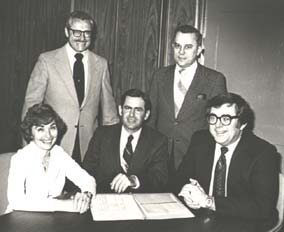
The first City Council seated left to right,
Marilyn Ryan, Gunther Buerk, and, Robert Ryan.
Standing Left to right, Dave “Cisco” Ruth and Ken Dyda
The election to incorporate Rancho Palos Verdes was finally held on August 28, 1973. An overwhelming majority of 5 to 1 voted in favor of incorporation.
The first City Hall offices were located in the former SOC offices in the Golden Cove Center at the corner of Hawthorne Boulevard and Palos Verdes Drive West. One of the first actions taken by the new City Council was to declare a building moratorium and to begin work on preparing the City €™s General Plan. The City offices eventually moved to the former Nike missile base administrative offices just above their first offices.
For more information about Palos Verdes and South Bay Real Estate and buying and selling a home on the Palos Verdes Peninsula, visit my website at https://rightreligion.stellarwp.site . I try to make this the best real estate web blog in the South Bay Los Angeles and the Palos Verdes Peninsula. I would love to hear your comments or suggestions.